
What is Cellular IoT?

While many people are familiar with Internet of Things technology, cellular IoT offers a way to connect IoT devices using existing cellular networks. This offers exciting new use cases for IoT and allows IoT technology to be implemented across a wider range of locations. So, what is cellular IoT?
Cellular IoT connects Internet of Things devices to the internet using cellular networks, such as 4G or 5G. It enables two-way communication between these devices and a centralised system. Cellular IoT offers wide-area, secure and reliable connectivity for devices, while 5G provides low-latency connectivity that’s ideal for real-time and mission-critical applications.
Keep reading for our in-depth guide to cellular IoT, including how it works, the benefits and the different types.
Jump to a section:
How Does Cellular IoT Work
Cellular IoT works by using existing cellular infrastructure to connect devices to the internet, allowing them to send and receive data. This enables remote monitoring, control and automation, without the need for Wi-Fi.
Here’s a step-by-step breakdown of how cellular IoT works:
- Device connection: A physical IoT device, such as a sensor or wearable, is equipped with a cellular module, such as a SIM or eSIM card. This allows it to connect to the nearest cellular network tower.
- Data transmission: When the IoT device gathers data, such as temperature or heart rate, it sends this data to a backend server or cloud platform using the cellular network.
- Network handling: The cellular network, including cell towers, base stations and core networks, securely routes the data packets to their destination.
- Data processing: The backend or cloud server receives and processes the IoT data. This can then be accessed by users through applications, allowing them to monitor and control the IoT device. The data can also be integrated into other systems or a dashboard.
Commands and updates: The system can also send commands or updates back to the IoT device, for example, a firmware update or a command to increase a thermostat.
Benefits of Cellular IoT
There are a wide range of benefits to utilising cellular IoT over other types of IoT technology.
1. Extensive Coverage
Cellular IoT works across cities, rural areas and even in vehicles and transportation. Wi-Fi offers significantly less extensive coverage and is only suitable for IoT devices operating in one building.
2. Highly Scalable
Cellular IoT is inherently scalable. Businesses can easily add or remove connected devices without needing to make infrastructure changes. It’s also highly flexible and can be used across static and mobile applications.
3. Cost-Effective
Because cellular IoT solutions utilise existing cellular infrastructure, cellular IoT devices can operate without any additional infrastructure or financial investment. Cellular infrastructure, such as towers and base stations, is already in place.
4. Enhanced Security
Cellular networks offer a range of security features, including encryption algorithms, such as SNOW 3G, as well as authentication protocols and secure network protocols like IPsec. These help protect the data that’s transmitted between cellular IoT devices. This makes cellular IoT an excellent option when sensitive data, such as patient or financial data, is being transmitted.
5. Reliability and Low Latency
Cellular networks typically offer faster speeds, better reliability and more consistent performance. This makes cellular IoT suitable for real-time and mission-critical applications that require low latency, such as autonomous vehicles, healthcare and industrial automation.
6. Remote Management
The connection between IoT devices and the centralised system is 2-way, allowing businesses to remotely troubleshoot issues, update firmware and optimise performance from anywhere in the world with an internet connection. This reduces the need for on-site visits, enhancing operational efficiency.
7. Wide Range of Applications
Cellular IoT is suitable for a wide range of applications across a diverse range of industries, including healthcare, manufacturing, retail and agriculture. For example, in healthcare, cellular IoT can be used to monitor patients more effectively through wearables and sensors. Learn more about the wide range of cellular IoT applications in healthcare in our blog, ‘Cellular IoT Applications in Healthcare’.
Types of Cellular IoT
There are a wide range of cellar technologies that can be used in IoT applications.
NB-IoT (Narrowband IoT)
This is a low-power wide-area (LPWA) network technology designed specifically to connect IoT devices to cellular networks.
Optimised for: Low power consumption and wide area coverage
Key Features:
- Low power consumption (battery life up to 10+ years)
- Excellent signal penetration (e.g. remote locations, basements and underground areas)
- Limited bandwidth (suitable for non-real-time monitoring)
- High connection density (supports a larger number of connected devices simultaneously)
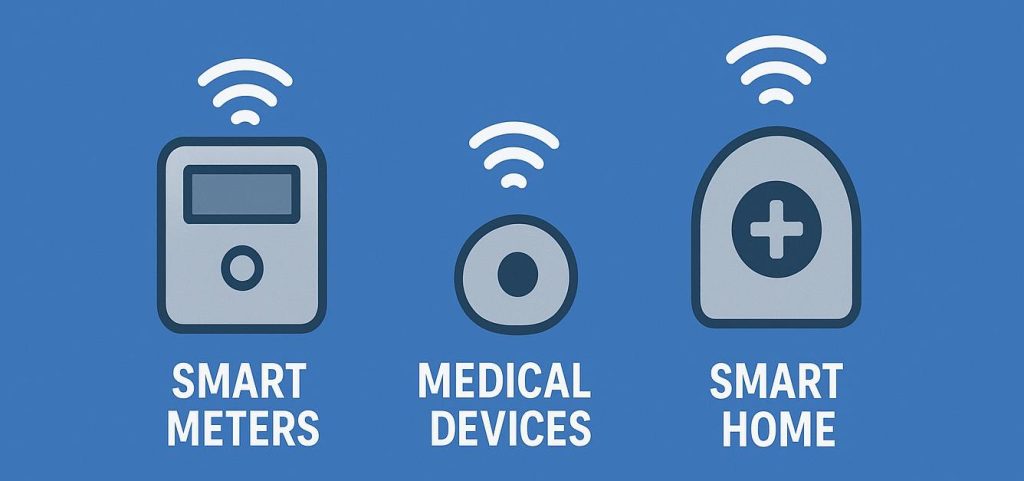
Use Cases: Smart meters, environmental and agricultural monitoring, parking sensors, asset tracking and industrial IoT
LTE-M (LTE Cat-M1)
LTE-M (Long Term Evolution for Machines) is a type of LPWA network technology that acts as a replacement technology for 2G and 3G services. It’s a specific type of LTE (often referred to as 4G) that has been optimised for IoT devices.
Optimised for: Low power consumption with better coverage and moderate data rates
Key Features:
- Supports voice (VoLTE), mobility and real-time communication
- Better latency than NB-IoT (more suitable for critical applications)
- Slightly higher power use, but supports more advanced devices (e.g. devices with GPS)
Use Cases: Wearables, vehicle trackers, medical devices and smart agriculture.
4G LTE (Cat-4 and above)
4G Long-Term Evolution (LTE) contains a range of performance categories, ranging from Cat 1 to Cat 22, with different power and data rates. Cat-4 and above offer higher data rates for more data-intensive applications, such as video streaming.
Optimised for: Medium to high bandwidth applications
Key Features:
- Supports audio, video and real-time data
- Higher data rates and lower latency (Cat-4 offers download speeds of up to 150 Mbps)
- More power-intensive than NB-IoT/LTE-M
Use Cases: Surveillance cameras, digital signage and fleet management
5G IoT
5G is the latest generation of cellular network and offers ultra-low latency and the ability to support a much higher number of connected devices than previous network generations.
Optimised for: Ultra-fast, high-volume, low-latency applications
Key Features:
- Very high bandwidth and device density
- Ultra-low latency for mission-critical applications
- Supports massive Machine-Type Communication (mMTC)
Use Cases: Autonomous vehicles, smart factories, remote surgery and AI-enabled IoT.
Learn more about the benefits of 5G connectivity in our blog, ‘What is 5G and How Does It Work?’.
2G/3G (Legacy Technologies)
The second and third generation cellular networks (2G and 3G) are being slowly switched off in the UK. Many network providers have already switched off 3G, and 2G will be switched off by 2033.
Key Features:
- Basic data transmission
- Lower-cost modules
- Limited long-term support
Use Cases: Older asset trackers, alarm systems and basic telemetry.
Which Is the Right Network for Your Cellular IoT Application?
Choosing the right cellular IoT network depends on the power usage, data rate, latency, coverage, cost and device mobility you require. For example, if your IoT devices don’t use real-time data transfer and you’re looking for a cost-effective option, NB-IoT is ideal for low-power, low-bandwidth applications.
The table below gives you a breakdown of the key features of cellular IoT networks to help you make the right choice for your intended application.
| Network | Use Cases | Power | Data Rate | Latency | Coverage | Mobility | Cost |
| 2G / 3G | SMS alerts, remote monitoring | Moderate to High | Low to Moderate (up to 2 Mbps) | Medium to High | Good to Excellent | Good | Low to Moderate |
| NB-IoT | Smart meters, parking sensors | Very Low | Low (tens of kbps) | High | Excellent | Poor | Low |
| LTE-M | Asset tracking, wearables | Low | Moderate(hundreds of kbps) | Low | Good | Excellent | Moderate |
| 4G LTE | CCTV, vehicle telematics | High | High (Mbps) | Low | Wide | Excellent | Higher |
| 5G | Autonomous vehicles, smart factories | High | Very High (Gbps) | Ultra-low | Expanding | Excellent | High |
Cellular IoT Applications
Cellular IoT can be implemented across a wide range of industries and sectors to enhance operational efficiency and increase automation. Below, we cover some of the industries where cellular IoT is having the biggest impact and the most common applications.
Healthcare
- Remote patient monitoring: patient vitals, such as heart rate and temperature, can be monitored and tracked through wearables.
- Emergency response: IoT devices in ambulances can share real-time data with hospitals while en route.
- Connected medical devices: Smart devices, such as infusion pumps, can send performance and usage data for alerts or maintenance.
Manufacturing
- Predictive maintenance: IoT sensors can collect data to predict machine failures and optimise maintenance schedules.
- Inventory tracking: IoT sensors can track materials and finished goods in real-time, improving supply chain efficiency.
- Automated production lines: Connected IoT devices enable automation of key production processes, increasing efficiency and reducing human error.
Retail
- Smart vending machines: IoT connected machines can monitor stock levels, sales data and performance, allowing for automatic restocking.
- Electronic Shelf Labelling (ESL). Electronic price tags can use IoT technology to automatically update prices to reflect discounts or promotions.
- Smart shelves: Shelves with IoT sensors can track inventory reducing the chance of stockouts.
To learn more about how cellular IoT is transforming retail, have a look at our blog, “How Are Smart Shelves Revolutionising The Retail Sector?“
Limitations of Cellular IoT
Cellular networks, especially newer technologies such as 5G, offer faster speeds, lower latency, and greater reliability than WiFi and many businesses choose cellular IoT to streamline their business processes and increase automation. However, many companies experience issues with poor signal strength. 5G is still only available outside 61% – 79% of premises (compared to over 99% of outdoor premises for 4G) and typically signal strength is poorer indoors.
If your business is struggling with poor indoor signal strength and it’s acting as a barrier to implementing cellular IoT, there is a solution to improving your connectivity – installing a high-performance 5G signal booster. Signal boosters provide businesses with access to high-speed, low-latency cellular networks that can power cellular IoT devices across a wide range of applications.
High-Performance Mobile Phone Signal-Boosting Solutions by NetCov
At NetCov, we specialise in designing and installing high-quality signal-boosting systems so businesses can implement cellular IoT technology. We have worked with a wide range of industries to help them enhance their connectivity and implement cellular IoT solutions, including:
We offer high-performance signal boosters that boost the signal of all UK networks, including Three, Vodafone, EE and O2. All our boosters are Ofcom-approved, so you can be sure your business is fully compliant with all UK legislation.
Contact our team today to find out more about how we can help your business implement cellular IoT or book your free consultation to get started.